

LOOK UP List: Humanising Tech
5 things to read, watch or do if you are selling technology

Technology used to feel like a discrete sector.
But nowadays, most scaled organisations, and a lot of smaller ones, feel more and more often like tech businesses.
We are all selling tech-powered solutions, tech-enabled ways of working, tech-inspired (but hopefully not tech-written) stories.
As the AI wave sweeps through the media and tech world, this tech-infusion might to accelerate until the technology is present in almost every decision, every interaction, every moment of communication.
But the truth is that most of us are still quite poor at telling stories about technology.
People routinely under-estimate audience’s resistance
People routinely overestimate their solution’s uniqueness
People routinely under-estimate the importance of humanity in the how
Throughout this month, we are going to be exploring the theme of humanising tech, through some interviews with brilliant tech storytellers, case studies, and our own LOOK UP Guide, coming in a few weeks, HUMANISING TECHNOLOGY.
For today, we are sharing 5 things that you can read, watch or try that will help you explore this idea, and perhaps rethink how you do it.
Enjoy!

1. Know where your audience stands
I see a lot of technology pitches that start with the basic assumption that people love change, and that everyone wants to get ahead of the pace of AI.
The truth is that people’s responses to AI and to tech more broadly are often extremely diverse by age group, country, and personal experience.
Most people are a complex bundle of hopes and fears, reservations and passions, and AI has all of these things working at fever pitch.
We’d strongly recommend getting as close to the data as possible - for example the IPSOS monitor, which is a brilliant resource on the divergence of different responses to AI around the world.

2. Ride your elephants
The practical barrier to creating technology is lower than ever, but the psychological and trust barrier to buying it is higher than ever.
That means you are going to need more than just a practical value proposition to attract a user - you need to have a really sound psychological, methodological, even spiritual basis for what you are doing, and why.
And it’s going to have to understand the elephants in the room for your buyer, address them, and ride them, not hope the question won’t be asked.
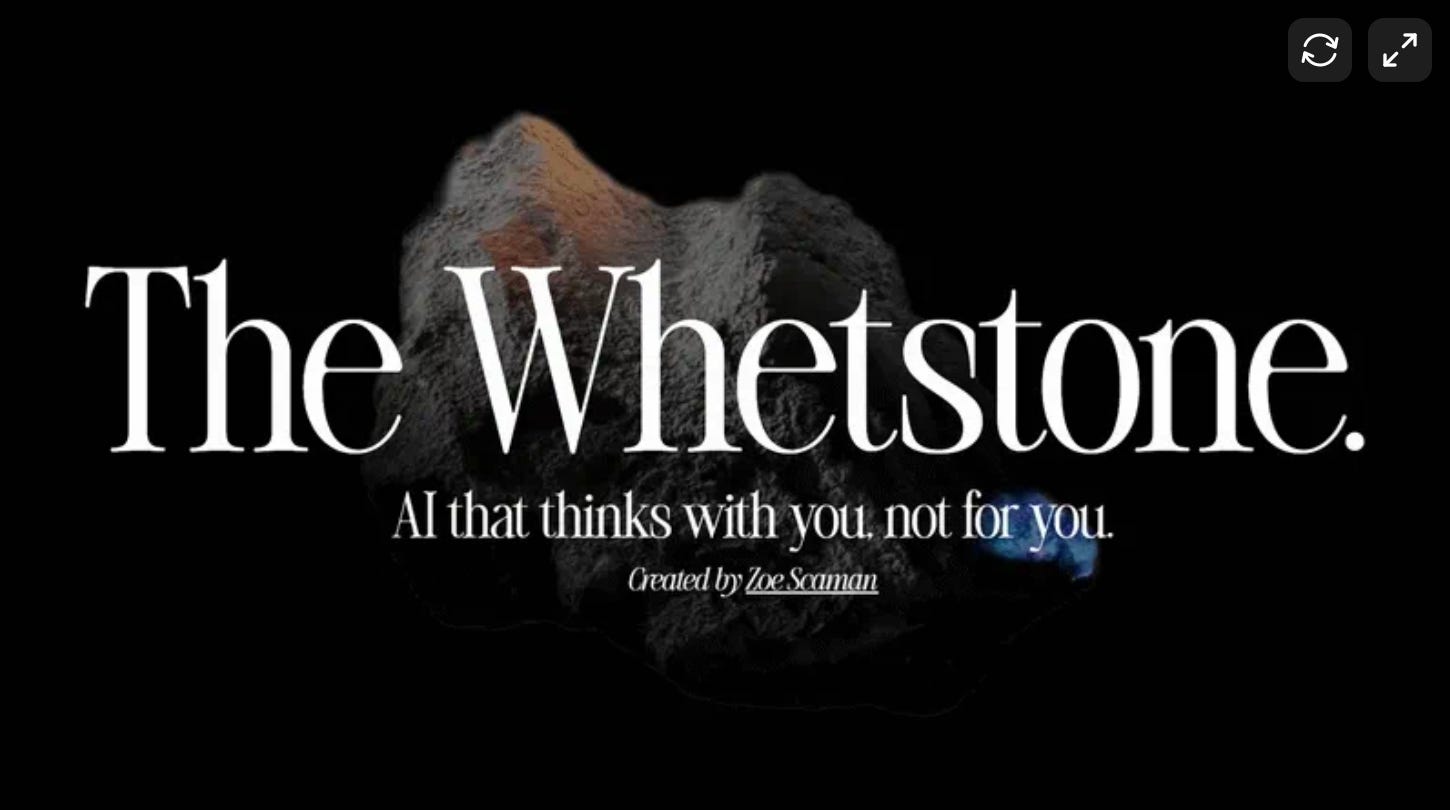
Your thesis doesn’t necessarily need to be quite as elegant as Zoe Scaman’s articulation of the why and how of her new product, The Whetstone, but if you’ve got a sceptical buyer, it certainly helps.
3. Make it feel human
When you sell technology, people aren’t buying the tool - they are buying their own future state.
So it’s your job to make that feel as real, and as human as possible. And we tend to put only a tiny proportion of the effort into imagining and realising that as we do into describing every detailed feature and every corner of the wiring diagram that made it.
It should, of course, be exactly the other way round.
This of course was a process that was definitively proven and completed by Steve Jobs, nearly 20 years ago, but despite the universal prevalence of this example, it’s still so hard to take on board.
So, as an alternative route, I am going to suggest that the next time you prepare a tech demo, instead of watching the too-familiar video of Jobs and his iPhone, you read this transcript. It’s informal, casual, delightful, and funny.

4. Test your limits with questions
Often when we conceive, create and build technologies, we think in an extremely linear way - which feels inadequate when technology sits at the intersection of so many complex and fascinating human and societal questions.
To really test the limits of what you are making, the rationale that sits behind it, and the full potential of its application, it makes sense to ask yourself imaginative questions. But that can be hard in heads-down mode!
So to help you look up, I strongly recommend downloading these ‘Tarot Cards of Tech’, created by the Artefact Group (and available for free.)
These are all great questions and perfect to test the limits of what you’ve built and why, and the story you can tell about it.

5. Contemplate your responsibility
We are in the middle of a technology shift that has quite awe-inspiring potential (for good and harm). The role our specific solutions, tools or stories, play may be pretty limited, but we are now all a part of unleashing and shaping the power of a technology that’s escaped from the lab and is roaming the earth.
You’ll find no shortage of contemporary hype or fear on that front, and there will be no easy solutions to the ethical questions of AI in this List!
But to contemplate your role, this may be a timely moment to explore the eternally powerful Frankenstein, by Mary Shelley. It’s perhaps the ultimate reminder of the responsibilities of a symbiotic creator/creature relationship with a human-like technology. And therefore a story that is highly popular and resonant with a new wave of AI explorers.
Also, there’s a lovely piece here about what it means for us, and our relationship with our AI creations. In essence - we can feel optimistic about our creations - but we need to be careful how we look after them.

Thanks for reading this month’s LOOK UP List, let us know anything you think we should read, watch or try.
And you can sign up to this month’s brilliant interviews here…